








 Source:

The wider strategic backdrop to the current tensions between Addis Ababa and Asmara is a relationship that has been steadily deteriorating for more than two years. What was once framed as a post-2018 normalization has gradually given way to distrust, military repositioning, and competing strategic visions. Today, the risk of renewed interstate conflict is no longer theoretical. Ethiopia, responding to what it describes as increased incursions by Eritrean forces into Tigray, has mobilized significant assets to its northern frontier. The forward deployment raises the probability of a confrontation that could involve not only the two states, but also armed non-state actors and regional stakeholders whose interests intersect across the Horn of Africa.
This military posture has unfolded in parallel with diplomatic overtures. In early February, Ethiopia’s Foreign Minister Gedion Timothewos circulated a letter to his counterpart in Asmara signalling Addis Ababa’s interest in “good-faith negotiations,” explicitly referencing access to the Red Sea through the port of Assab. The formulation was deliberate. It acknowledged that maritime access has become the core strategic variable shaping Ethiopian calculations. Since the loss of its coastline in 1993, Ethiopia has depended overwhelmingly on Djibouti for trade. The leadership now frames diversified sea access not merely as an economic preference but as a structural necessity tied to sovereignty and long-term security.
Assab has therefore become the focal point of Ethiopian triangulation. The port carries historical resonance, logistical logic, and political symbolism.
Beyond the bilateral dispute lies the spectre of subversion and proxy manoeuvring. Eritrea has currently exploited Ethiopia’s internal security dilemmas and is fuelling the movement of armed groups in the country.
It is within this deteriorating climate that external mediation has gained urgency. A recent briefing by the International Crisis Group identified Saudi Arabia as a credible mediator, building on both precedent and recent diplomatic signalling from Riyadh. The precedent is significant. In 2018, after two decades of a costly “no war, no peace” stalemate, Ethiopia and Eritrea signed the Jeddah Peace Agreement in Jeddah under Saudi auspices. The agreement formalized a rapprochement that had already begun politically but required external anchoring to consolidate. For a brief period, it opened the path toward renewed economic connectivity, including discussions about Ethiopia’s potential use of Assab.
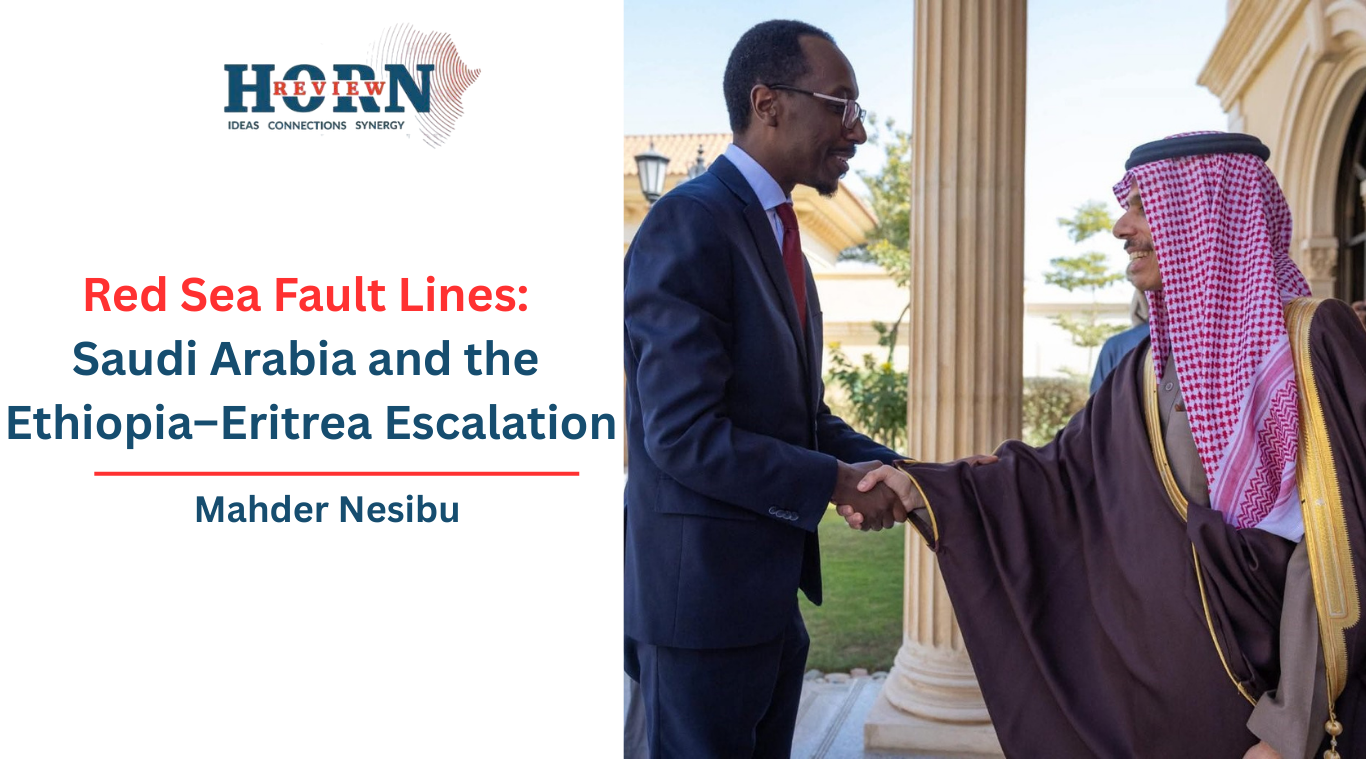
Recent Saudi diplomatic choreography suggests that Riyadh is again testing the ground. Within days of the Ethiopian foreign minister’s letter, the Kingdom dispatched its foreign minister to Addis Ababa while a senior deputy held talks in Asmara, including with President Isaias Afewerki. The sequencing signalled parity and seriousness. Riyadh was not merely offering good offices; it was positioning itself as a stabilizing actor in a rapidly destabilizing theatre.
Why assumes the risk? The answer lies in the Kingdom’s own strategic exposure. A war between Ethiopia and Eritrea would reverberate far beyond their shared border. The Horn of Africa currently hosts overlapping crises: Sudan’s civil war and fragile transitions in Somalia an interstate war layered onto this matrix could fracture trade corridors, generate refugee flows, and create permissive space for armed groups. For Saudi Arabia, whose western coastline stretches along the Red Sea, the implications are immediate.
The Red Sea is not simply a body of water; it is a strategic artery linking Europe and Asia. It is already congested with naval deployments from global and regional powers. Insecurity has risen sharply, with maritime routes periodically disrupted. To the south, Yemen’s protracted conflict has exposed Saudi territory to missile and drone attacks and complicated shipping lanes. The Kingdom continues to view the emergence of a stable, Saudi-aligned order as essential.
An Ethiopia–Eritrea war would further destabilize Saudi Arabia’s southern neighbourhood. The presence of the Houthis in Yemen, the volatility in Sudan, and the fragile political landscapes across the Horn form a contiguous arc of risk. From Riyadh’s perspective, allowing another fault line to rupture would compound existing vulnerabilities. Preventive diplomacy therefore becomes an instrument of self-defence.
Yet risk avoidance is only part of the calculus. Saudi Arabia’s foreign policy is itself undergoing recalibration. After years marked by caution following the costly intervention in Yemen, Riyadh has begun to project a more assertive regional posture reminiscent of the early ascent of Crown Prince Mohammed bin Salman. The Kingdom now seeks to shape, rather than merely absorb, regional dynamics. This shift is visible from the Levant to the Gulf and increasingly along the Red Sea corridor.
The Horn of Africa has consequently risen in Saudi strategic thinking. The Bab el-Mandeb chokepoint, ports along the African littoral, and the political trajectories of Red Sea states all intersect with Saudi economic diversification plans and maritime security priorities. Stability along this corridor underwrites trade, energy flows, and the credibility of Saudi Arabia’s ambition to position itself as a central node between continents.
Complicating the picture is Riyadh’s evolving relationship with the United Arab Emirates. Once closely aligned on regional theatres, the two Gulf powers have experienced visible friction. Divergences over Yemen, competition in logistics and finance, and differing approaches to regional partnerships have introduced strain. The UAE has cultivated extensive influence in the Horn of Africa, including port concessions and security partnerships. Its footprint is arguably deeper and more institutionalized than that of any other Middle Eastern actor.
Saudi Arabia must therefore operate in a crowded field. It faces not only local complexities but also competition from partners-turned-rivals. The Red Sea arena has become an extension of Gulf power politics. If Riyadh can broker or anchor a durable understanding between Ethiopia and Eritrea, it would reinforce its credentials as the principal Arab stakeholder in the western Red Sea basin.
Other actors further complicate the environment. Israel has expanded diplomatic and security ties across parts of the Horn, reportedly exploring strategic access points along the coast. Global powers maintain naval presences and economic stakes. In this context, mediation is also a means of preserving influence. By shaping outcomes, Saudi Arabia limits the strategic vacuum that others might fill.
The critical question, however, is whether a new agreement can transcend the limitations of past accords. The Jeddah framework of 2018 was transformative in symbolism but uneven in implementation. Ethiopia and Eritrea have signed and abandoned agreements before. Border demarcation, normalization mechanisms, and economic integration have repeatedly stalled. The pattern suggests that formal treaties alone are insufficient.
What would be stronger than another treaty? The answer likely lies in a structured, phased arrangement that embeds incentives, verification mechanisms, and third-party guarantees. Rather than a declarative document, a durable settlement would resemble a managed process: sequenced confidence-building measures, monitored demilitarization steps, and binding economic frameworks tied to tangible benefits. Access to Assab, for instance, could be structured through long-term leasing, joint development authorities, or revenue-sharing mechanisms anchored in international law. Such arrangements would move beyond symbolic reconciliation toward institutionalized interdependence.
For Addis Ababa, the leadership speaks of a “give and take” formula. That language implies readiness to offer economic or other inducements in exchange for maritime access. For Asmara, the calculus will hinge on regime security and leverage. A framework that recognizes Eritrea’s autonomy while creating predictable gains may be more persuasive than rhetorical appeals to fraternity. Saudi Arabia’s potential role would then shift from broker of a moment to custodian of a process. Riyadh could convene, underwrite, and monitor implementation, possibly in coordination with other regional stakeholders. Its credibility would depend on perceived neutrality and sustained engagement rather than episodic diplomacy.
The stakes are considerable. A miscalculation between Ethiopia and Eritrea could ignite a conflict with cascading regional effects. Conversely, a carefully structured accommodation could stabilize a critical corridor at a time when the Red Sea system is under acute stress. For Riyadh, involvement is not altruism; it is strategic necessity shaped by geography, competition, and ambition.
By Mahder Nesibu, Researcher, Horn Review


