








By Mahder Nesibu, Researcher,
For the entirety of Eritrea’s existence as a sovereign state, various groups have stood in opposition to the dominance, and later the authoritarianism, of the EPLF and its successor, the People’s Front for Democracy and Justice (PFDJ). From the Eritrean Islamic Jihad Movement and the Eritrean Liberation Front-Revolutionary Council (ELF-RC) to the Afar Revolutionary Democratic Unity Front (ARDUF), these formations stood in ideological and political opposition to the PFDJ and had, more or less, failed to challenge the regime’s authoritarian grip or extract meaningful concessions on the character of its rule. Opposition parties came and went across the three decades of the war and the post-1993 state period. A new and revitalized set of actors now constitutes that bloc, setting out their plans for an Eritrea without the PFDJ and confronting a substantially altered set of challenges.
The opposition today faces a PFDJ that is, in its essential character, more or less unchanged. In practical terms, the various opposition formations, both unarmed and those with a growing military wing such as the Red Sea Afar Democratic Organization (RSADO), pose little capacity to force change in Eritrea. Armed presence has not translated into political leverage, and the regime’s grip on the country’s coercive apparatus remains intact.
What has changed, rather, is Eritrea itself and the international environment in which it now operates. And this shift presents its own challenge to an opposition that seeks, eventually, to fill a political vacuum. Once ostracized and shunned by the international community and its neighbours, the PFDJ is now the subject of renewed interest from major powers, most prominently the United States. More significantly, Eritrea has become integrated into an increasingly complex security architecture involving powerful and assertive Gulf states whose interests extend across the Red Sea and into the Horn of Africa. A regime that was diplomatically isolated is now diplomatically relevant. For an opposition that had long counted on the regime’s international pariah status as a source of vulnerability, this rehabilitation complicates the picture considerably.
By unchanged, the PFDJ and President Isaias have also stagnated in hard power terms relative to the institutional depth and military capacity of neighbouring states. The Eritrean People’s Liberation Army (EPLA) and later the Eritrean Defence Forces (EDF), once among the most effective fighting forces in the region, is today considered a relic in contrast to the defence establishments of its neighbours and the broader regional neighbourhood. More critically for Eritrea’s future, and for any opposition seeking to envision that future, the PFDJ never built the institutions a viable state requires to sustain itself. The promises of the early period of statehood, across the domains of constitutional governance, economic development, and public education, were never honoured. Eritrea’s civilian institutions remain skeletal.
That institutional void may not, however, be the most serious challenge the opposition faces. Within the Eritrean political opposition, the deep fractures of Eritrean society are visible, and they raise real questions about whether a post-PFDJ transition could hold together.
The Eritrean Blue Revolutionary Front, the most visible opposition formation in recent years, carries a broadly democratic and nationalist orientation and draws its base primarily from the vast Eritrean diaspora in the West. This diaspora concentration is itself a product of the PFDJ’s coercive governance, most visibly expressed through the indefinite national service obligation that has driven a sustained human exodus and left Eritrea contending with the many ills that follow depleted human capital, a hollowed-out professional class, and a demographic challenge that will prove critically consequential for any future reconstruction. The Front operates, however, within a diaspora that is deeply divided. For a significant portion of the diaspora community, the PFDJ remains the institutional expression of Eritrean nationalism, the vanguard of the liberation movement’s achievement, and a bulwark against supposed external enemies. The diaspora landscape is split between those who identify the regime with the nation, and those who, with greater accuracy, identify it with the nation’s ills.
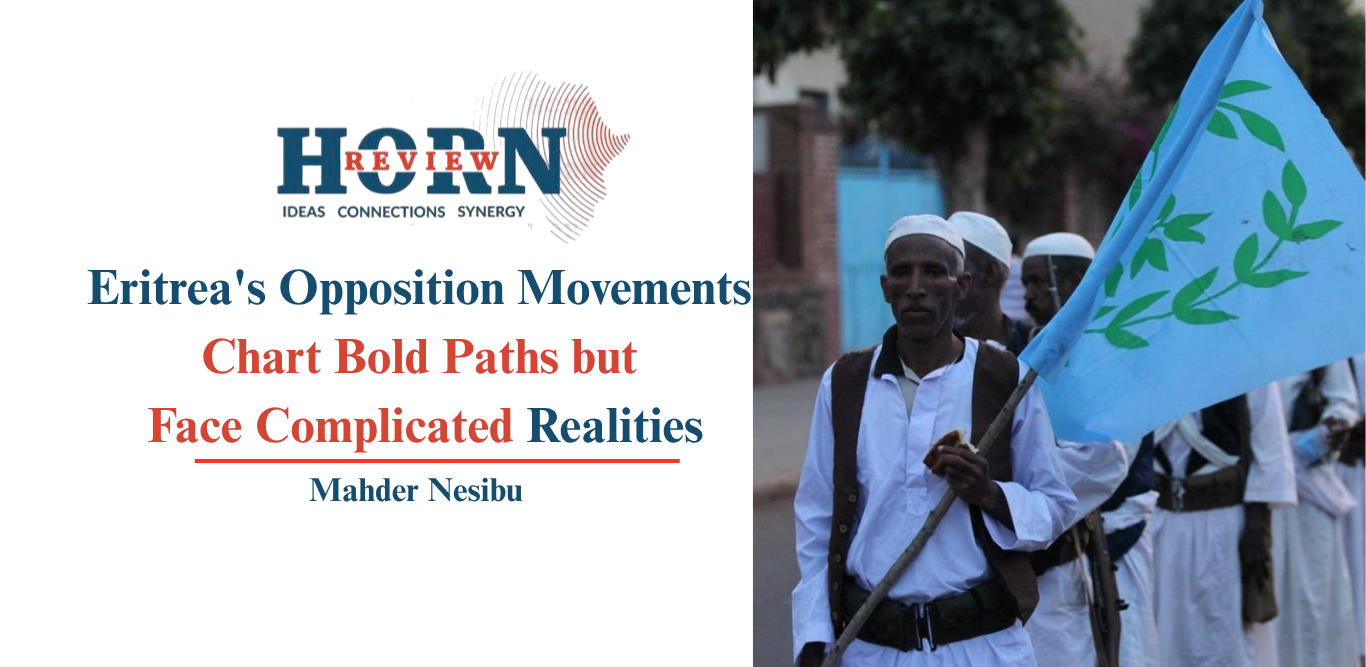
A parallel current, broadly Islamist in orientation, articulates grievances rooted in the PFDJ’s historically Tigrinya highland, predominantly Christian power structure, and its suppression of the Muslim political currents that were foundational to the original Eritrean movement. This tendency finds expression in formations such as the “Green Revolution” alignment, and it speaks to constituencies that the secular democratic opposition has struggled to incorporate.
Movements like the RSADO, ethnic in nature, move to challenge the EPLF’s premise of Eritrean national unity, a premise that has always found weak reception among the Afar communities inhabiting the vast Dankalia region along the country’s eastern and southern coastline.
Whether divided by ethnicity, religion, or competing conceptions of what Eritrea is and ought to be, a post-PFDJ political order would need to grapple seriously with these fissures.
More realistically than outright removal of the PFDJ in its present form, these opposition groups appear to see the regime’s gradual decline, and the inevitable death of President Isaias and his equally aged inner circle, as the most viable opening for establishing a political foothold inside Eritrea and advancing an alternative path for the country.
A prevalent assumption, shared among parts of the opposition and, critically, within Ethiopia’s own strategic leadership, is that the PFDJ without Isaias and the founding generation would cease to be viable and would disintegrate. This assumption is shallow. It dismisses the complexity of what “Shabia”– the popular name for the EPLF as a political and cultural tradition — is and its deep resonance within the broader current of Eritrean nationalism as its supposed vanguard. There is a succession crisis, certainly. But to conclude that the EPLF as an institution would dissolve is to misread the organizational depth and nationalist legitimacy of the liberation front itself, and its unavoidable presence in Eritrea’s political future, whatever form that takes.
The opposition nonetheless holds assets that give its long-term project genuine weight.
The diaspora is the most significant. Eritreans abroad now constitute a substantial share of the country’s total population, a proportion reflecting decades of forced emigration. In contrast to the impoverished and politically suppressed population inside Eritrea, the diaspora commands financial resources, professional capacity, and organizational networks. Mobilizing that base is the EBRF’s central political wager.
Equally significant is the role of Ethiopia. Addis Ababa has provided sanctuary to multiple Eritrean opposition formations, a posture that likely reflects longer-term calculations about Eritrea’s political trajectory and Ethiopia’s capacity to shape outcomes in a neighbouring state in which it holds deep and multiple interests.
Across their considerable differences, the opposition movements share a consistent argument; that the persistent animosity between Ethiopia and Eritrea is a product of PFDJ policy, not of structural or historical necessity, and that a reconciliation of interests and a more constructive bilateral relationship is achievable. Whether that argument can be tested depends, above all, on whether the opposition can first build the internal cohesion that its current landscape so visibly lacks.
Source:Horn Review


