








 Source:
Over the years, I have read countless articles and commentaries about Somaliland in the Arab world. One thing has always struck me. Too often, Somaliland itself is not the subject. Instead, discussions revolve around the interests of others. Israel. Ethiopia. The UAE. The United States. Somaliland becomes the backdrop rather than the story.
That is unfortunate, because the Somaliland question did not begin with any of these countries, and it will not end with them either. For many observers, Somaliland comes into focus only when it appears in a wider debate about the Red Sea or regional rivalries. Yet Somaliland is not a foreign project. It is a political reality shaped by its own history and by the choices of its own people. Perhaps that is why so much commentary misses what has actually happened over the past three decades.
Since restoring its sovereignty in 1991, Somaliland has had limited engagement with much of the Arab world. Many preferred to view it through Mogadishu rather than engage directly with Hargeisa. The expectation, whether stated openly or not, seemed to be that time would eventually resolve the issue. It did not. Thirty-four years later, Somaliland remains. More than that, it is more stable, more institutionalised and more deeply rooted in the consciousness of its people than at any point in its modern history. It rebuilt its institutions, maintained peace, held multiple elections and achieved democratic transfers of power, largely without the international attention and resources devoted elsewhere.
An entire generation has grown up knowing only Somaliland’s institutions and political reality. For many young Somalilanders, the debate is no longer about separation. It is simply about the country they have always known. Those who expected time and isolation to weaken Somaliland’s aspirations underestimated how deeply they had taken root. National aspirations rarely disappear simply because they are ignored.
Another misconception is that Somaliland’s aspirations somehow run contrary to Arab interests. The people of Somaliland have been connected to the Arabian Peninsula for centuries through trade, religion, culture and family ties. Somalilanders have lived, studied and worked across the Arab world for generations. Likewise, Arab traders and businesses have long been part of Somaliland’s economic life. A stable Horn of Africa and a secure Red Sea serve Arab interests no less than African ones.
Somaliland itself must also accept some responsibility. For too long, it did not do enough to explain its history and experience to Arab audiences. As a result, many people across the region know little about Somaliland or the circumstances that shaped its political journey. But the issue was not always a lack of information. More often, discussions were shaped by assumptions inherited from another era. Somaliland was viewed through the lens of preserving an established regional order rather than through its own history and experience. That gap was frequently filled by narratives driven more by regional competition than by fact. Which perhaps explains why discussions about Israel, Ethiopia and foreign powers so often come before discussions about Somaliland itself.
Thirty-four years ago, few would have predicted that Somaliland would emerge as one of the most stable political systems in the Horn of Africa. Yet that is precisely what happened. The more interesting question today is not why other countries engage with Somaliland. It is why, after more than three decades of peace and effective self-government, so many still prefer to understand it through the calculations of outside powers rather than through the aspirations of Somalilanders themselves.
If the Arab world wishes to understand Somaliland, it should begin not with Israel, Ethiopia or any other external actor. It should begin with Somaliland itself.
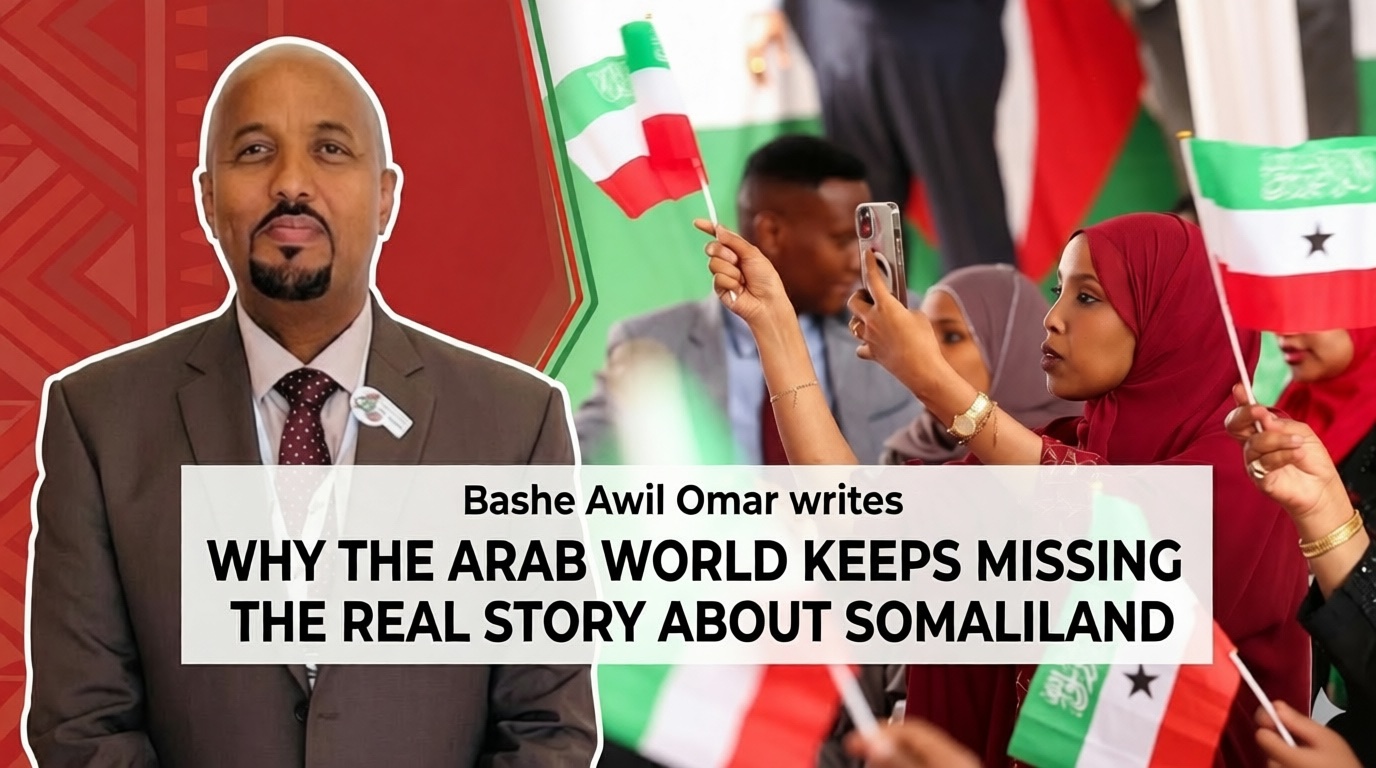
Bashe Awil Omar is a diplomat and politician. He served as the Somaliland Representative to the UAE (from 2015-2018) and Kenya (from 2018-2021).
Disclaimer: The views and opinions expressed in DNE Africa Opinion section are those of the writers and do not necessarily reflect the views or positions of DNE Africa.


